test

Showing posts with label dad. Show all posts

Tuesday, October 29, 2013

remembering dad


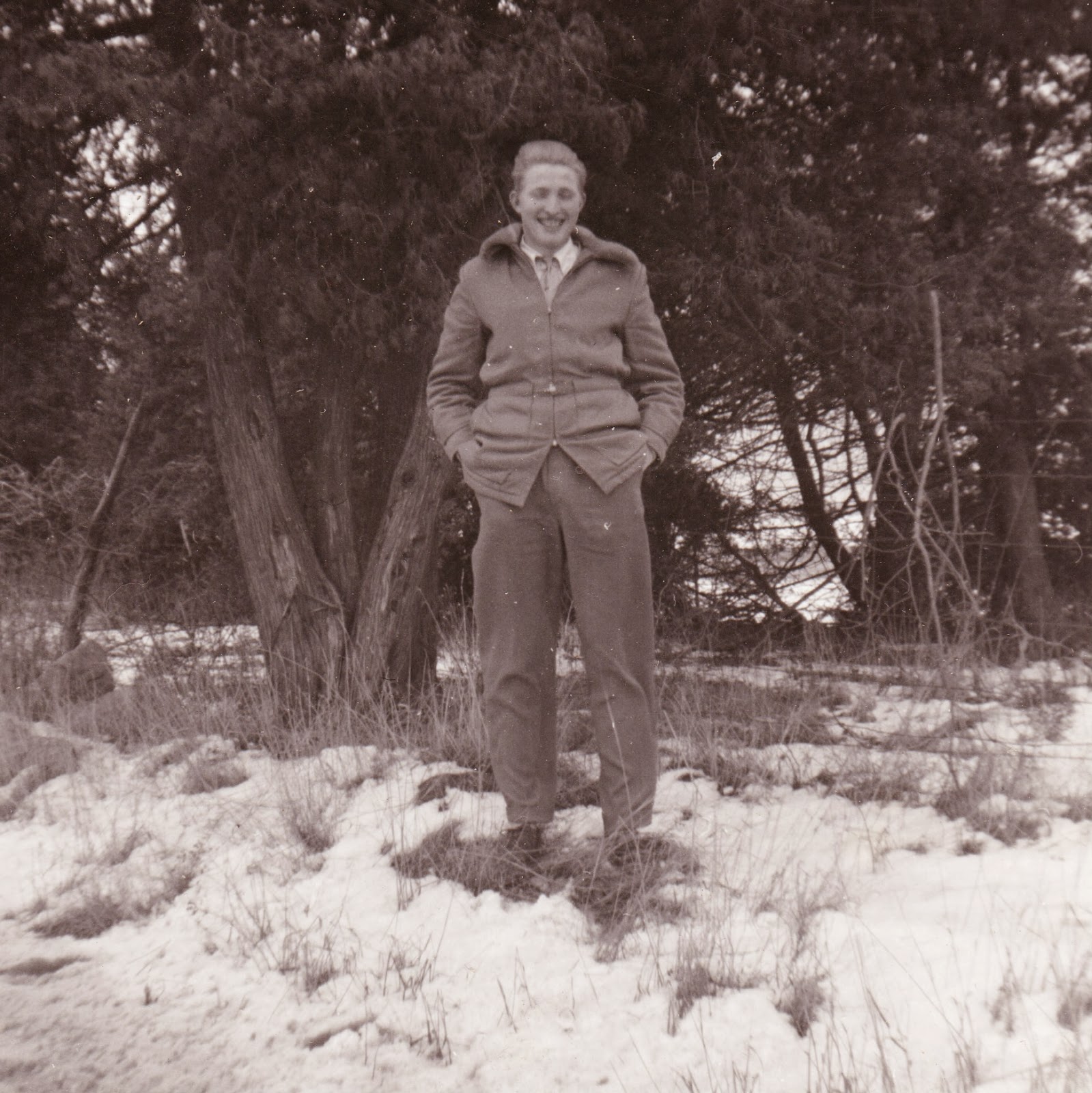
While sorting through some papers, I stumbled upon a copy of my Uncle Nick's speech from my parent's wedding. Uncle Nick is a gifted writer and storyteller (seems to be a trend in the Dykstra family!), who was responsible for translating and editing my grandfather's autobiography. A cousin of mine then had published a few years ago.While I obviously wasn't around to hear the original speech, as I read it all these years later, it sure brought back memories of my dad. This is a little snapshot of my family history, and I am proud to be able to share it with you all.

**********************

"I have known Hessel all his life, ever since he replaced me as the baby in the family. Mind you, being more than two years old I did not think myself a baby anyway. And because I was big, and he was small, it always was my job to look after him. A job I tried to avoid as much as possible--forcing Hessel to learn on his own. That's how Hessel learned to become very stubborn. Nobody ever saw him make any mistakes. (I did not say that he never made any mistakes--nobody ever saw him make any.) Least of all, his big brother. You could not prod nor tease him into doing anything that he had not mastered yet. When Hessel said "no!" he did "no."

As toddlers, we were always tied onto a rope to keep us from wandering off. If I could not untie the knots, I ended up strangling myself. [Younger] brother Bill was fortunate enough that during the war years, rope was made from paper. After keeping it in his mouth long enough to soak it, he could tear it apart and make his getaway. Hessel [in contrast], would bring the rope to Mom to show his desire to go outside without running the risk of making mistakes. 

As a five year old, he broke his arm. A bike fell on him. Nobody ever saw his attempt to learn to ride that thing. Shortly thereafter, he drove the two wheeler all over the village without ever ending up against a fence, in a hedge, a ditch, or the canal--like all the rest of us.

Where we grew up [in Holland], the farmers' fields were separated by ditches, 6-12' wide, 3-6' deep, filled with water and mud. As kids, each spring, we spent our time roaming these fields accompanied with a long pole, whose only purpose was to get us across these ditches. Favourite ditches were used for days on end for practice purposes, showing off, or competitions, till the banks were slimy from all the activities. Competitions ranged not only on jumping the farthest with or without climbing that pole during the process, but also on placing the pole closest (or on) the near bank or the far bank, hanging on the pole as high (or low) as possible, hanging on with one hand only, etc.... The inevitable result was always: a dunking. It's an official spectator sport now, called pole vaulting.

Dad gave Hessel a pole too. A beautiful blue painted pole. Mine had never been painted. [But] Hessel would not use his pole. Sometimes he disappeared, (with his pole, I think.) Weeks later, he showed up at our favourite ditch and jumped over it. On the wrong side of the pole. Thereafter, he jumped over every ditch. Hessel never came home with wet feet like the rest of us.  

One day he showed up at the canal where we were swimming. Hessel dove in, swam right across, and back. I never knew how he learned it.

He got his high school diploma in three years. Never studied like the rest of us, so it seemed. 

I took driver's lessons for three days from the car salesman who sold us our first car. After a so-called driver's test, I got my license, and proudly drove the car home, only to meet Hessel as a hitchhiker. I stopped and opened the passenger door for him. Hessel walked over to the wrong side and told me to move over. 'You have your license, I don't,' he said. 

So I tried to teach him:
#1 This is the wheel, for steering.
#2 That is the gearshift.
#3 There is the gas pedal.
#4 There is the clutch.
#5 That is the brake to stop this thing.
'Now, step on #4, step on #3, put #2 in left hand rear position, let go of #4.'
Hessel drives away, no jerks. First gear. 
'Then, step on #4, move #2 ahead to right and up, step on #3, let go of #4.'
Hessel speeds up in second gear, no gear scratching, no jerks.
'Well, step on #4, move #2 as far back as it will go, let go of #4.'
Hessel speeds up to 45 mph--top speed of the car. No gear scratching, no jerks, stayed on the right side of the white line.
Beginner's luck? Let's try again:
'Ok, step on #5, now on #4."
Hessel stops on the right side of the road, on the shoulder. No jerks, motor still runs, did not stall.
Repeat whole process with same result.
I gave up.

The next week, Hessel gets his license, and drives for 30 years without banging into anything. Like all the rest of us.

Hessel also waterskies. When he gets tired of standing on both legs, he kicks off one ski and continues on one leg like a stork. I never saw him fall. Like the rest of us.

Hessel and Dad started a farm in 1953. Hessel bought 1 cow, and Dad 50 chickens, to populate the 65 acres. Three years later, they buy another farm of 100 acres. Hessel had 5 cows. Dad's chickens are dead. In 1973 dad retired, (no chickens,) but Hessel had a purebred Holstein herd for which he has received the top trophies in the County for several years, along with the trophy for the highest producing cow in the County. He now farms approximately 300 acres, and is fully mechanized to run it all by himself

So friends, that is Hessel.
Stubborn.
Self-made.
Successful.
Never made a mistake.
We all like him for it.
Kids and animals adore him.
The community appreciates him.

He has in the past, (or is now) serving as Director of the Holstein Frisian Association, member of the Christian Farmer's Association, deacon and steward of the Bloomfield CRC, board member of  Quinte Christian High School, and probably other organizations. 

Today we have witnessed the vows Hessel has exchanged with Connie before God, our Maker and Saviour, and we celebrate with them. We wish them a very happy life together. 

As Hessel's choice, we know, he made no mistake. 
He took his time.
His eyes wide open -- we thought he was looking the other way!
Nobody suitable in Canada, for 31 years.
Nobody suitable in Holland, 3 visits in a row.
He found her in New Jersey, USA.

Since then, his life had changed. This summer alone already he has:
Gotten extremely nervous.
Broken the hay baler. 
Chickened out of a swim at the Outlet when the water was too cold.
Dented the door on his pickup truck.
Got an infection in his left arm.
Gotten disorganized doing chores after three days of visiting Connie in New Jersey.
Losing some of this hair.

So Connie, your job's cut out for you already. He needs you now more than ever, to snap him out of this very uncharacteristic trend--so that 15 years from now, he'll say that today he made the only mistake in his life; he should have married you 15 years earlier!

Hints to the bride:
Hessel loves thick green pea soup or brown beans. Especially on Saturdays.
Hessel likes a weekly bubble bath in his own bathtub.
As far as I know, all Hessel knows about women is that they need lots of cupboards and closets. That's why he built hundreds of square feet of closets--and as an afterthought, some rooms around it to make it look like a house. He bet me that there's no woman in the world that can fill them up. Show him, Connie! I'd like to collect."
-by Nick Dykstra, August 21, 1982


Mr. & Mrs. Hessel Dykstra

Monday, June 17, 2013

a day with my dad

***********************************

This essay was originally written for one of my university writing classes, and given to my Dad on his birthday in 2003. While I have taken a few liberties as a writer, (one can't be expected to remember all the details of a typical day from ages 3-6), this is an accurate reflection of time spent on the farm with my dad .  The most precious memories I have of my dad are from these days.

***********************************

"It's time to get the cows," my dad says, pushing back his empty teacup, and I eagerly jump from my chair, ready for action. 

"Don't forget to change your clothes," says my mom. I scamper off to my bedroom and emerge a few minutes later wearing my barn clothes: a pair of denim overalls that are too short, a faded t-shirt and a green cotton hat - "your milker's cap" my mom tells me.

"Let's go," says my dad as he pulls on his other running shoe, sticking the Velcro. He is far too impatient for lace-up shoes, unlike myself, who just can't manage laces yet. We both say goodbye to mom. My dad then dons his cap and we head out to the machine shed to get the tractor. Unwilling to be left behind, I have to run in order to keep up with my dad's long strides.

"Start 'er up," says my dad, as he shoves in the clutch of our Massey. I turn the key and my dad puts it into gear. He guides the tractor out of the shed and into the dusty lane, in the same manner he has done for as long as I can remember.

"Okay, your turn," he says, gesturing towards the steering wheel. For a brief moment I am terrified, but the sensation soon passes. After all, even though I am so much smaller than this huge machine, the lane is straight, and my dad is here, so everything will be all right.

 It is cool and shaded in this part of the lane. Wild plum trees line one side of the lane, and long grasses sway gently on the opposite side. My dad reaches up and plucks a handful of plums from one of the branches above us. From time to time he does this, popping plums into his mouth one by one, and spitting out the pits over the side of the tractor.

Soon we reach the bend in the lane where my dad takes over the wheel again. We enter the pasture and my dad parks the tractor in its usual spot. Then we make our way down the steep hill. Below us is the pond. It is at least twice as big as a swimming pool, but at this time of the year it's a murky green, "because of the algae," says my dad.

At the edge of the pond, partially hidden by the long grass, lies the pump. I am terrified of coming close to the edge because I cannot swim yet. The pond is over twelve feet deep in the middle - two of my dads standing on top of each other. 

"Go find the hose," my dad instructs, as he attempts to start the pump. One pull of the rope...I scamper off in search of the hose, buried somewhere in the long grass nearby. Two pulls...the pump starts with a puff of smoke, and I dump the hose into the first water trough just in time.

With the sound of the pump, the cows head down the pathway toward the water troughs. The first trough is so old, it's made of stone. The numbers 1935 are engraved along the top. "That's the year it was made," my dad tells me. I do not completely understand how old this makes it, but I'm sure it must have been on this farm forever.

I retreat from the troughs as the cows begin to gather. By the time the whole herd arrives, the second trough, a newer aluminum one, is nearly full as well. "It's going to run over!" I shriek. My dad just laughs and runs to shut off the pump just in time. Meanwhile, the cows drink thirstily. "On a hot day, a single cow can drink over 100 gallons of water," my dad says.

At last, the troughs are empty. We drive the cows back up the pathway and they head for the lane. Back on the tractor, my dad and me take up the rear. It is slow going, but several handfuls of plums later, the cows are driven into the barnyard, the gate is closed behind them, and the tractor is safely back in the machine shed.

When the cows have found their proper stalls, my dad heads for the grainary. He flips on the switch and grain pours out the end of the auger into the wooden wheelbarrow below. I put my hand out and catch some of the kernels. They tickle my palm. As I open my fingers, the kernels fall back into the wheelbarrow, creating miniature golden dunes.

Once the wheelbarrow is full, my dad wheels it out in front of the cows. With the large plastic bowl, he measures out the scoops of grain that each cow is to receive. Some receive more, some less. I have only memorized how many scoops each cow in the first row receives, so my dad begins feeding on the opposite end of the barn, working his way back towards the grainary. By the time he reaches the first row of cows, the wheelbarrow is much lighter, and I am able to push it along. Now I'm on my own. While my dad prepares for milking, I finish the rest of the grain feeding.

My dad, meanwhile, heads for the milkhouse. He flips a few switches and then carries the milking machines out to the other side of the barn. He strides back to the milkhouse and carries out the bucket of warm, soapy water and the wooden, painted green stand that holds the stack of paper towels and cup of iodine. 

By this time, I am finished with my task. I rejoin my dad, awaiting his next instructions. As soon as the first milking machines come off, he nods, and I grab the cup of iodine. Gingerly creeping in between the two cows, I dip each teat into the iodine, leaving a purple stain behind.

After we have begun milking the second row of cows, my dad heads back toward the milkhouse. I grab the 2.5-gallon plastic pails from the shelf and line them up in a row. He fills each one of them with milk and then checks the weight of each on the rusty scales hanging from the ceiling. When all six pails are filled with just the right amount of milk, I carry them off to the hungry calves. One pail in each hand, I struggle towards the pens. The full pail knocks against my legs and a little milk sloshes out onto my overalls.

Setting down one pail, I open the door to the first pen. An energetic black calf with a white triangle marking on on her face greets me and immediately begins sucking at the milk in the pail, even before I can set it inside her pen. I do the same for the calf in the pen right beside this one. Once the milk is gone, the calves still suck at the bottom of the empty pails. No matter how hard I pull on the handles, I can't free the pail; the suction is too strong. "I'm stuck! I'm stuck!" I cry to my dad. He comes running to my rescue, and with a swift yank, the pails come free.

I take the empty milk pails back to the milkhouse and repeat the process. As I return to the pens with the next round of pails, the calves that have just eaten are sucking on each other's noses through the peep-hole in the side of the pen, making it look as if they are kissing. I giggle and continue on with the feeding.

Once this is finished, I return to help with the milking. When we are finally finished, my dad cleans up the milkhouse while I fill the cats' feed bowls. Tiger, the black and grey striped cat perches atop the wall of the calf pen, overseeing the process. I give him a scratch under the chin and he purrs contentedly. 

Back inside the milkhouse, my dad takes a plastic cup off the shelf, dips it into the milk tank, and hands it to me. Without this, our day together would not be complete. I savour the rich, cold milk. My dad has a taste too. "Ah, that sure hits the spot," he says, swallowing the last of the milk,"I guess we're done for tonight." Glancing at his watch, he adds, "Let's go have our supper." I follow him out of the barn and down the driveway, back toward the house where my mom is waiting with supper. I am tired but content. Another day of helping my dad on the farm is done.


************************************

Happy Father's Day, Daddy!
xoxo


Thursday, June 13, 2013

for dad

Dear Daddy,

Today is your birthday and it seems unreal that you've been gone for over three years already. I wish you could be here to see how we finished renovating the upstairs our of house. Thank you for believing in that dream of mine, and for encouraging me (already in high school) that it could be done. Thank you for waiting until I graduated university, instead of tearing it down, like you threatened so many times.  Thank you for all the hours of work you did on the place that summer, when you should have been working on the farm.  For all the things you didn’t understand about me, the one thing that you totally got was that “you can’t have two women in the same kitchen,” especially if those two women were me and Mom. Thank you for helping me fly the coop and achieving at least one of my dreams. 
I wish I could have known you better, but I think the eulogy below (written by your sister) really sums up what you were all about.

Miss you always.
xoxo

In Loving Memory of Hessel Dykstra (1935-2010)

I love my brother Hessel. It’s my privilege to have this opportunity to celebrate who he was, from my point of view, over the years. We’ve all experienced him in our own ways, of course, but I think any one of you can relate to something of who I’ve experienced him to be.
Hessel was a nature lover. Early in his life already he dreamed of someday having his own farm. It was that dream that had a lot to do with our family immigrating to Canada in the early 50’s. God honoured his dream as he grew in knowledge and maturity to pursue it with the family’s backing.

Most of my memories of growing up with him are pretty funny. We had a good time together, even though he was the big brother for my sister and me. He was an incessant tease so we learned to defend ourselves. It was a big joke with us that he’d have to run around the kitchen several times in order to collect his thoughts before he headed out to run some errands or leave on a significant trip. We were smart enough, usually, to give him space lest our backside got in the way of a smacking hand in his travels.

We played lots of Monopoly on Sunday afternoons. He was a shrewd Monopoly player and he knew how to get my goat. He ate like a horse and stayed thin like a reed. I was so envious as a teenager because I didn’t have that problem. Jane or I would be trying out our baking skills, some days, he’d sniff the air and blow into the house to sweep up anything that looked edible and hadn’t left the cookie sheet in one piece, and call them “misbaksels” (baker’s mistakes). Sometimes the “misbaksels” were burnt and he ate those too, as a favour, so we wouldn’t have to admit that we’d wasted food. That was frowned upon in our home. It was also his way of saying he had faith in us for a better day.

I remember the tomato summers when the family was faced with picking 5 acres of the red globes for the daily trips to the canning factory. The job would start in the heat of August and continue until the first frost in September, or sometimes October. Some days were so hot that the tomatoes sizzled in the sun and you almost burned your hands on the sunburned ones. Hessel could sense my silent seething against the drudgery and heat that was suddenly wilting any motivation to fill another crate. Well, he knew there was nothing like the sudden splat of an over-ripe tomato square in the chest, to pump up the adrenaline. His aim was perfect. So was mine. And we’d be back at top performance for a while again. I didn’t mind child labour as much if he were around. We did a lot of laughing.

He was a very sensitive guy. I remember the day the dog died after a nasty farm accident. He wasn’t too ashamed to hide his tears. He let me cry with him, even though he was a grown man. That’s probably one of the reasons I’ve always felt emotionally close to him.

Hessel was a gardener. He loved his flowers and had an ongoing war with the earwigs over the ownership of his stock of geraniums around the house. We always knew what would delight the other as a birthday gift. He supplied me with a flat of bedding plants that he carefully selected each year at the beginning of May and we knew that a flowering shrub or rose bush would always be welcome when it was his turn. The climbing rose in front of the garage was his favourite, I think; he’d make a point of telling me how many blooms it showcased. He also grew the best tasting pears in all of North America, which he liberally shared with us. His vegetable garden grew well in the former barnyard. Whenever we’d visit on a Sunday, he’s be proud to show his neatly-kept batch of strawberries, raspberries, beans, potatoes, and whatever else was growing at the time.

He was also a shrewd farmer. He learned from the best, as a teenager freshly implanted from The Netherlands into a new culture at the Thompson family farm. They taught him to understand the value of having a purebred herd of cattle. And he experienced the glory days of having the best herd of Holstein cows in the County on several occasions. He understood the land he was responsible for and he knew himself to be a steward of all that had been allotted to him by the Lord. He was careful about pollution, and what crops grew best in the different types of soil on his farm. He worked hard to get the land ready as early as possibly for receiving the new seed each year. It was a game to see which of his farming compatriots would be the first to have the land seeded and the first cut of hay ready for the baler. But it was also his sense of responsibility that motivated him. He kept his ear tuned to the weather forecasters and his eye on the sky for sunshine or rain, and his intuitive sense calculated when the crop needed to be ready to be able to tolerate the dry seasons.

Hessel was a generous man. I owe much of my post-secondary education to his sense of family support for one another. When my high school years were over and I had aspirations of going to Calvin College, there weren’t the easy answers of applying for government funds through OSAP. Hessel’s response to my SOS for tuition payment was simply, “Well, we’ll just have to sell one of these cows.” I know others of you have tasted of his generosity as well. He also didn’t like to waste, so if he didn’t think a cause had merit, you’d be wasting your time waiting for a hand-out.

He didn’t need a lot for himself personally. Vacations weren’t very feasible for a farmer with a herd of cows. The only ones he trusted to milk for him, on the few times he did take a break, were his nephews, Chuck and Rick. When they left the area and got married, he stayed put. Until his knees gave out. He saw only one course to take after that, and that was to sell the herd. Even then, the only way he could justify a vacation was to give to the Lord the same as he was spending on himself.

Hessel was someone you could count on once he had given his word. I remember his public profession of faith many years ago. The scripture that the pastor gave to the group of young people with him was Romans 10:11, “If you confess with your mouth, ‘Jesus is Lord’ and believe in your heart that God raised him from the dead, you will be saved.” Well, he didn’t spout off at the mouth much about his faith, but he lived it in very practical ways.

The Lordship of Jesus meant he had responsibility for the needs of others. He committed himself to getting involved in Christian education long before he ever found Connie and had children of his own. Farming was a moral task and he became an active member of the Christian Farmer’s Federation. He became a board member of Parkside Village because providing a Christian community home for the elderly was important too.

He wasn’t perfect, of course. Those of you who lived with him on a daily basis know that when his frustration level reached its peak, he could lose his temper, or disappear into a dark mood. Connie had to cool him down more than once when the heifers didn’t behave themselves on their way in and out of the stable in the spring. And when machinery broke down and new parts didn’t fit, he preferred nobody around to listen to him vent.

He wasn’t the world’s greatest optimist either. It didn’t take much to discourage him, sometimes, and he lived by Murphy’s Law—if something can go wrong, it will. Those clouds that would come rolling in with a promise of rain would split when they arrived at the corner of Scoharie Road and the Highway, leaving a lovely patch of blue as far as Picton, where the two sections would meet again and pour out their accumulation in a deluge over the dusty pavement of the town and empty out into the bay.

He was also a cautious man. From childhood on, he was known to us more or less as never attempting anything until he was sure he could safely handle the task. Nick tells us he never went swimming with the boys in Holland until he knew how. Where he ever learned is a mystery to the whole family. And when he went pole vaulting over the ditches in Friesland, he didn’t come home wet like his older brother either. It took him 46 years to be sure he could handle asking the first woman on a date, and Connie trusted he was reliable and she could marry him.

My most cherished memory of Hessel, however, is of the mealtimes with him and his family when we were privileged to experience dinner devotions with them. I remember his simple prayers of faith in his compassionate God who always daily provides what is needed. Cancer robbed him of the joy of eating the meals he always relished so much. But that ordeal is over. I believe he may now sit with Jesus at the banqueting table and enjoy the feasts of paradise. 

“Eye has not seen, ear has not heard, nor mind conceived what God has prepared for those who love him.”

-by Rennie VanderWal